Key Takeaways
- The IRS sends three crypto letters: Letters 6174 and 6174-A need no response, while Letter 6173 has a respond-by date and can lead to an examination referral if ignored.
- The IRS says on its own website that these letters are not an audit; a separate notice, the CP2000, proposes tax changes when broker reports such as Form 1099-DA do not match your return.
- Starting with 2025 sales, crypto brokers report customer transactions to the IRS on Form 1099-DA, and customer copies were due February 17, 2026.
- You must answer the digital asset question on Form 1040 whether or not you received a Form 1099-DA, so no letter does not mean no reporting problem.
- An amended return filed before an IRS audit contact may qualify as a qualified amended return, which can remove the 20 percent accuracy-related penalty on the corrected amount.
We’re seeing more IRS Letters 6174, 6174-A and 6173 go out to crypto investors who didn’t fully report their crypto. If one showed up in your mailbox, or you’re worried one might, this is for you.
I’m Andrew Gordon. I’m a tax attorney and a CPA, and I’ve focused on crypto tax since 2014. I recorded a short video on these letters, and this article covers the same ground with the IRS sources behind each point.
The short version: the three letters are different, the data behind them is new, and the people who act before the IRS escalates have more options than the people who wait.
What are IRS Letters 6174, 6174-A and 6173?
They are IRS voluntary compliance letters sent to taxpayers who may have unreported crypto, and they range from educational (6174) to a request that requires a response (6173). The IRS describes all three on its voluntary compliance letters page.
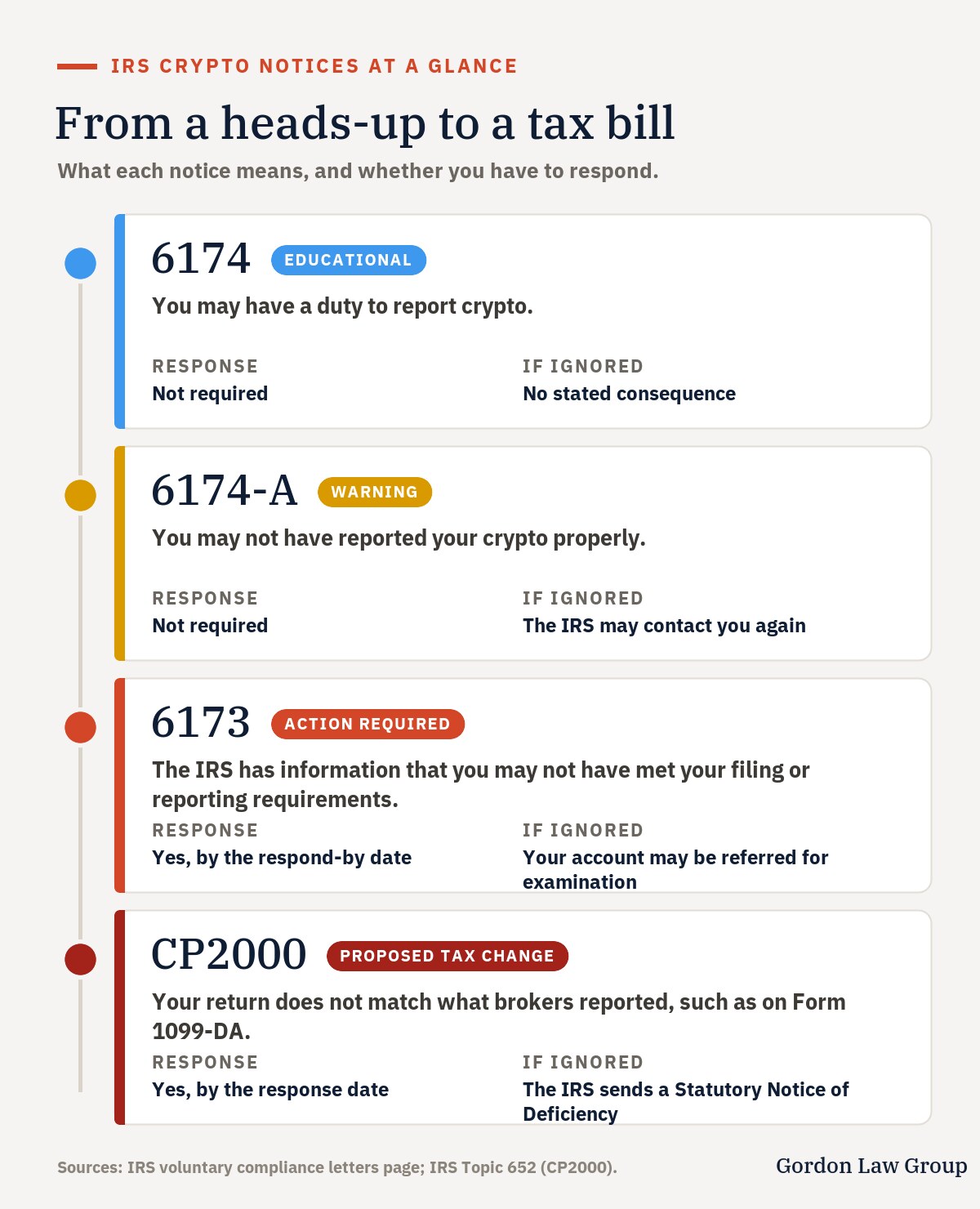
Letter 6173 is the serious one. It asks you to file or amend your returns, or to explain why you’re already compliant in a statement signed under penalties of perjury. Read that last part twice before you sign anything.
What about a CP2000 notice for crypto?
A CP2000 is a different IRS notice: it proposes changes to your tax return because the income your brokers reported doesn’t match what you filed. The IRS says a CP2000 isn’t a bill, but it is a proposal to adjust your tax, and it comes with a response date. Unlike Letter 6173, it already lists a proposed amount.
This is the notice that 1099-DA data is most likely to produce. If a broker reported a crypto sale on Form 1099-DA and that sale isn’t on your return, the CP2000 may treat the full proceeds as income, because most 2025 forms don’t include cost basis. Your actual gain may be far smaller, but it’s on you to show your basis.
- Respond by the date on the notice. The IRS asks for a reply within 30 days of the notice date, or 60 days if you live outside the United States, and you can call to request more time.
- Agree, partly agree, or disagree. If you disagree, you send a signed response with documents that support your numbers. If the notice is right but you have other income, credits or expenses to report, the IRS says to file Form 1040-X with “CP2000” written on top, according to its CP2000 guide.
- Don’t ignore it. If the IRS doesn’t hear from you by the response date, it sends a Statutory Notice of Deficiency, which starts the clock on your right to go to Tax Court.
A CP2000 is often the cheapest point to fix a crypto mismatch, because the fix may be paperwork rather than a dispute. For a step-by-step walkthrough, see our guide on how to respond to a CP2000 notice.
Is my IRS crypto letter real?
Check the letter number on irs.gov before you respond, because scammers are mailing fake crypto letters too. In a July 2026 fraud alert, IRS Criminal Investigation warned that fake letters are targeting crypto holders and said the IRS does not run any “Digital Asset Compliance Portal.” Until you have confirmed a letter is real, do not enter wallet details or contact information on any site it names.
Why are more IRS crypto letters going out now?
Data. For the first time, crypto brokers had to report customers’ 2025 sales to the IRS on Form 1099-DA, and customer copies were due February 17, 2026, according to IRS Tax Tip 2026-07. Most of those forms do not include cost basis for 2025 transactions. Proceeds with no basis on the IRS side and nothing on your return is the kind of mismatch that produces letters.
The IRS also has customer records from exchanges through court-approved John Doe summonses, a process described in the Internal Revenue Manual. More data means more matching.
And if your crypto never showed up on a 1099, you still had to report it. The digital asset question on Form 1040 must be answered every year, whether or not you received a Form 1099-DA, under the Form 1040 instructions.
Didn’t get a letter? You can still have a problem.
A missing letter is not a clean bill of health. The letters go out from data the IRS already has, and that data grows each year. After working with more than a thousand crypto investors, my advice is simple: whether you received a letter or not, if you have unreported crypto, now is the time to clean it up.
You don’t need a huge portfolio for this to matter. A few situations that come up again and again:
- Trades that never made it onto a return. Swaps between coins are taxable even when no dollars come out.
- Staking and airdrop income left off. Rewards are generally income when you gain control of them.
- An exchange that closed or merged. The records may be harder to get, but the reporting obligation didn’t go away.
- Years with no return filed at all. Unfiled years tend to get harder to fix the longer they sit.
How do you fix unreported crypto?
This is fixable, and the path depends on what happened. The IRS directs people with honest mistakes to amended or past-due returns, and reserves its Voluntary Disclosure Practice for willful noncompliance.
- You filed but left crypto off. That usually means amended returns on Form 1040-X.
- You didn’t file at all. That means filing the past-due returns.
- The problem was intentional. The IRS Voluntary Disclosure Practice may apply, and it has timing rules. A disclosure generally isn’t timely once the IRS has opened an examination or has received information about you from a third party, such as a John Doe summons. The IRS proposed changes to the program in December 2025 (IR-2025-124), and if finalized they take effect six months after the final terms are published.
Timing matters for penalties too. The IRS says these letters are not an audit and are not a contact for purposes of a qualified amended return. Under Treasury Regulation 1.6664-2(c)(3), an amended return filed before certain IRS contacts, including an audit contact, may be treated as a qualified amended return, which can remove the 20 percent accuracy-related penalty on the corrected amount. Once an audit starts, that option is generally gone. It does not help with fraudulent positions.
Got a letter? Send it to us for an attorney review. We read it, walk you through your options, and handle the reply.
Why talk to a tax attorney before you answer a 6173?
Because what you send the IRS can be used, and the privilege that protects your conversations depends on who you talk to. Conversations with a CPA can be protected by a limited federal privilege under 26 U.S.C. § 7525, but it does not apply in criminal tax matters. Attorney-client privilege can.
I’m a CPA too, and I still say: if your situation might be more than an honest mistake, start with an attorney. That matters most before you sign a 6173 statement under penalties of perjury.
Frequently asked questions
Do I have to respond to IRS Letter 6174?
No. Letter 6174 is an educational letter and the IRS does not require a response. It does mean the IRS has information suggesting you hold or traded crypto. If your past returns left crypto off, amending them now, before any audit contact, may keep penalty relief options open that disappear once an examination begins.
What happens if I ignore IRS Letter 6173?
The IRS may refer your account for examination. Letter 6173 has a respond-by date and asks you to file or amend returns, or explain in a statement signed under penalties of perjury why you are already compliant. Missing that date gives up the chance to fix the issue before an audit, so get advice and respond on time.
Is an IRS crypto letter an audit?
No. The IRS says on its voluntary compliance letters page that Letters 6173, 6174 and 6174-A are not an audit and are not an examination contact. That matters because an amended return filed before an audit contact may qualify as a qualified amended return, which can remove the 20 percent accuracy-related penalty on the corrected amount.
Does the IRS know about my crypto if I didn't get a 1099-DA?
Possibly. Brokers report 2025 sales on Form 1099-DA, and the IRS has used court-approved John Doe summonses to get exchange records. Either way, Form 1040 requires you to answer the digital asset question every year, whether or not you received a 1099-DA, so unreported activity is still your responsibility to fix.
How do I know if an IRS crypto letter is a scam?
Look up the letter number on irs.gov and compare it to the IRS description. In July 2026, IRS Criminal Investigation warned that fake letters are targeting crypto holders and said the IRS does not run a “Digital Asset Compliance Portal.” Never enter wallet details or seed phrases on a site named in a letter.
Should I talk to a CPA or a tax attorney about an IRS crypto letter?
If there is any chance your situation is more than an honest mistake, start with a tax attorney. The CPA privilege under 26 U.S.C. § 7525 does not apply in criminal tax matters, while attorney-client privilege can. An attorney can then bring in accountants to prepare the corrected returns.
What is an IRS CP2000 notice for crypto?
It is a proposal to change your tax return because third-party reports, such as Form 1099-DA, don’t match what you filed. It isn’t a bill, but you must respond by the date on the notice. If you don’t, the IRS sends a Statutory Notice of Deficiency. Showing your cost basis can reduce or remove the proposed tax.
Get help with an IRS crypto letter
Crypto tax software can rebuild your transactions, but it can’t tell you whether to amend, file late, or consider voluntary disclosure, and it can’t protect what you say. At Gordon Law, our tax attorneys review your letter and your history, and the accountants at Gordon Tax prepare the returns, so the legal strategy and the numbers come from one team.
The firm was founded by a tax attorney and CPA and has focused on crypto tax since 2014. A letter is not an audit, and you have more options when you act first instead of waiting.
Have an attorney review your IRS letter
No letter yet but worried about past years? Schedule a confidential consultation.