Key Takeaways
- A tax opinion letter explains your tax position. An attorney reviews your specific circumstances, explains how the law applies, and evaluates how likely your position is to hold up if challenged by the IRS.
- It may help protect you from penalties. A written opinion documents the professional advice you relied on and can help demonstrate that you acted in good faith, which may help you avoid certain accuracy-related penalties.
- Certain situations may call for an opinion letter. These include complex crypto transactions, significant scam or theft losses, business transactions, international tax issues, and other situations where a substantial amount of money or tax is at stake.
- Not every tax situation requires one. If the tax rules are clear, the amount at stake is relatively small, or you need help responding to an existing IRS inquiry, a tax opinion letter may not be the right solution.
- It’s best to get an opinion before filing a tax return or completing a transaction. An opinion obtained after filing a tax return, for instance, generally cannot establish that you relied on professional advice when you originally took the tax position.
A tax opinion letter is a document prepared by an attorney that explains why the attorney believes a particular tax decision is allowed under the law. The letter also outlines the legal reasoning behind that decision and explains how likely it is to hold up if the IRS disagrees and challenges it.
Most taxpayers will never need one, but if you’re preparing to close a business deal, claim a significant tax loss, or make a tax decision involving an issue the IRS hasn’t clearly addressed, such as the taxation of certain cryptocurrency transactions, an opinion letter may be worth considering. Without one, a disagreement with the IRS over your tax position could result in a penalty of 20% to 40% on top of any tax owed.
This guide explains what a tax opinion letter does, when it may be worth the cost, when you probably don’t need one, and what to expect from the process.
Video: A quick look at when a tax opinion letter may make sense and why timing matters.
Not sure you need an opinion letter? Use our two-page checklist to see whether your situation is one of the exceptions.
Download the checklist: Do You Need an Opinion Letter? (PDF) ↓
What a Tax Opinion Letter Actually Does
A tax opinion letter serves two main purposes. First, it helps you understand how strong your tax position is and whether it is likely to hold up if the IRS challenges it. Second, it documents the professional advice you relied on and can help show that you acted in good faith when making that decision, which may help protect you from penalties if the IRS disagrees.
It explains how strong your tax position is
Tax law is often unsettled, and the laws on the books don’t always provide a clear answer for every situation. Many times, there’s room for interpretation.
A tax opinion letter doesn’t simply give you a yes-or-no answer. It allows a tax attorney to evaluate how the law applies to your particular circumstances and then explain how confident the attorney is that your position would hold up if challenged.
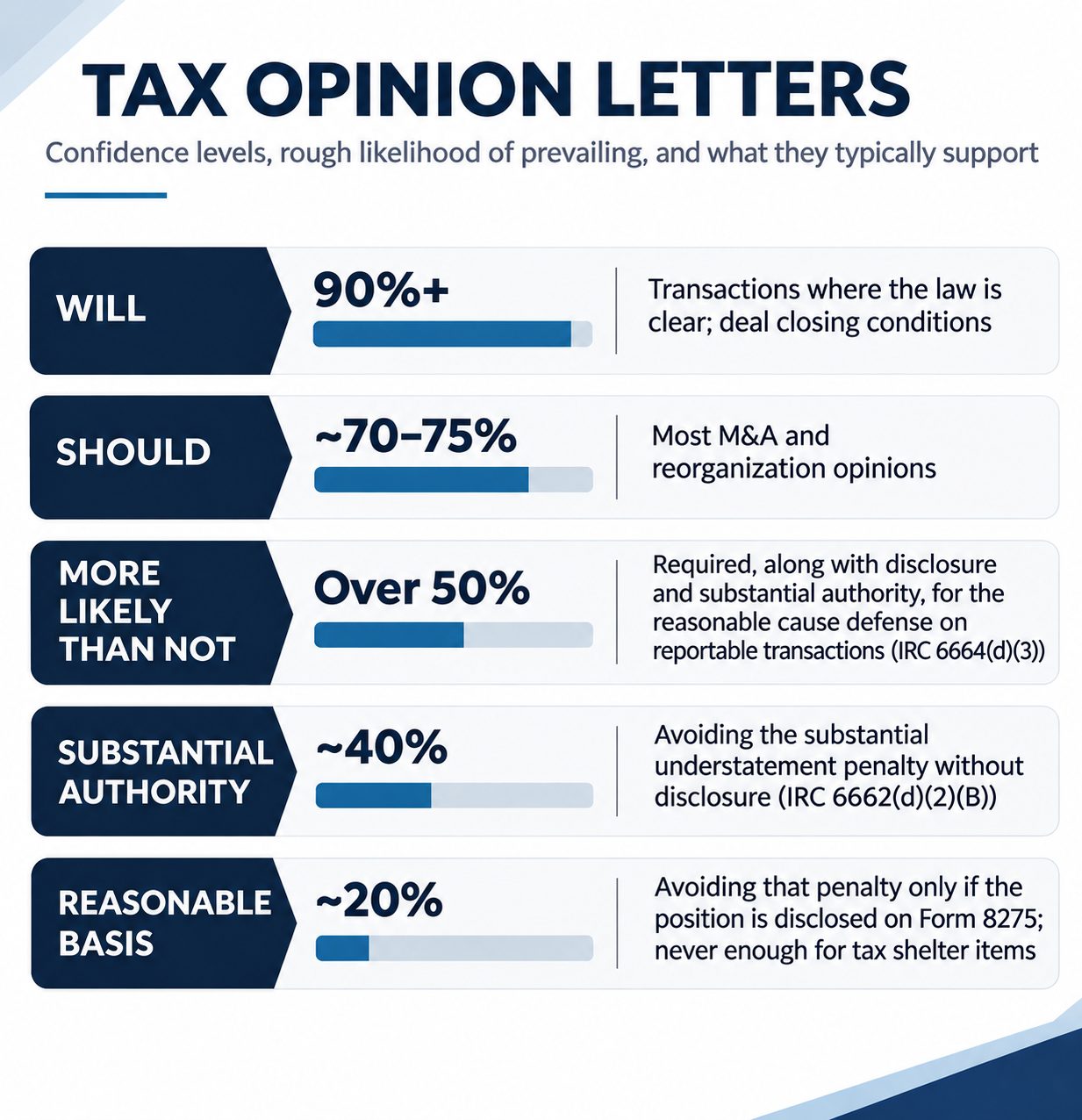
These confidence levels have specific names that are commonly recognized by tax professionals and the IRS. Each one generally corresponds to a different likelihood of prevailing. It is important to note, however, that the percentages below are practitioner rules of thumb, not numbers set by law.
It can help protect you from penalties if the IRS disagrees
If the IRS determines that your tax position is incorrect and disallows it, you could face an accuracy-related penalty of 20% of the resulting tax underpayment. In certain cases, that penalty can increase to 40% (or even greater). This applies to gross valuation misstatements, undisclosed transactions lacking economic substance, and undisclosed foreign financial asset understatements (IRC 6662).
However, you may be able to avoid these penalties by showing that you had reasonable cause for taking the position and acted in good faith (IRC 6664(c)). Relying on professional advice can help establish this, but only if the advice was based on all the relevant facts, did not rely on unreasonable assumptions, and your reliance on that advice was reasonable (Treas. Reg. 1.6664-4(c)).
A written opinion letter can provide documentation of the advice you received and the reasoning behind your decision, helping demonstrate that you took the position in good faith.
What a tax opinion letter doesn’t do
A tax opinion letter is simply the attorney’s analysis of how tax law applies to your situation. It does not mean that the IRS has reviewed or approved your tax position, and it does not require the IRS or a court to agree with your attorney’s conclusion.
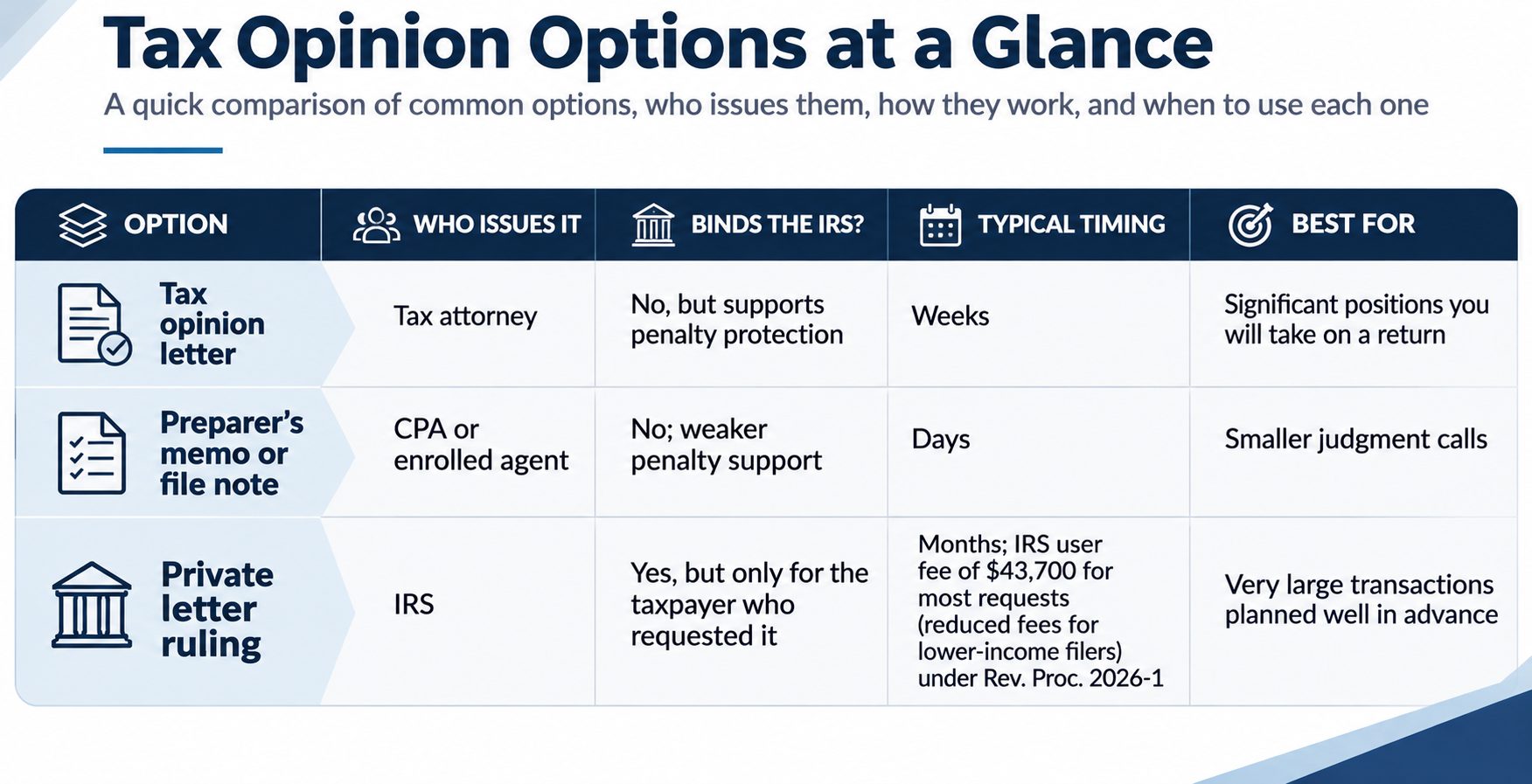
If you need an answer directly from the IRS that is binding for your situation, you would need to request a private letter ruling instead. However, the IRS does not issue private letter rulings for every type of tax question or request.
When You Need a Tax Opinion Letter
A tax opinion letter may be worth considering when a significant amount of money or tax is at stake and the tax law doesn’t provide a clear answer for your situation. In these cases, an attorney can review the facts, explain how the law applies, and document the reasoning behind the tax position you’re considering.
Here are some situations where a tax opinion letter may be helpful.
Crypto transactions the IRS has not addressed
The IRS has issued guidance on some of the most common cryptocurrency transactions, including basic sales, hard forks, and staking rewards. However, it hasn’t clearly addressed the tax treatment of some other activities, such as wrapping tokens, moving cryptocurrency between chains, or depositing assets into liquidity pools (IRS digital assets guidance).
The IRS has also issued Notice 2024-57, which temporarily excludes brokers from reporting certain wrapping and liquidity provider transactions on Form 1099-DA until further guidance is available, but that doesn’t determine whether these transactions are taxable. If you’re treating one of these transactions as non-taxable and the amounts involved are significant, a tax opinion letter can explain the legal reasoning behind that position and document why you’re taking it. See our crypto transaction opinions.
Deducting a loss from a crypto scam or theft
The tax treatment of stolen money depends heavily on the circumstances surrounding the loss. For example, personal theft losses are generally deductible only when they result from a federally declared or state-declared disaster (IRC 165(h)(5)). However, losses from transactions entered into for profit fall under a separate rule, Section 165(c)(2).
In CCA 202511015, released March 14, 2025, the IRS Chief Counsel addressed how these rules apply to different types of cryptocurrency scams. The guidance concluded that victims of investment-style scams, including pig butchering scams and situations involving compromised accounts or phishing that drained an investment account, could deduct their losses. However, victims of romance scams and fake-kidnapping scams could not.
The distinction depends on the specific facts of the loss, and large deductions may draw IRS scrutiny. If you’ve lost a significant amount of money to a crypto scam, an opinion letter can help establish how the law applies to your circumstances. See our scam loss opinions.
Buying, selling, or restructuring a business
Because a business transaction can have significant tax consequences, buyers, sellers, or lenders may require a tax opinion letter before a deal can close. For example, they may want an attorney to confirm that a business reorganization qualifies for tax-free treatment or that a business entity is classified correctly for tax purposes.
Large or one-time transactions that involve a judgment call
Some tax situations don’t come up often enough to have an obvious answer. You may need to determine whether a large gain should be treated as capital or ordinary income, whether securities are worthless or a debt qualifies for a bad debt deduction, whether an unusual charitable contribution is deductible, or when income should be reported. When the tax consequences are significant, an opinion letter can explain the legal basis for the position you’re taking.
International tax positions
International tax issues can involve complicated rules and reporting requirements. For example, you may need to determine how a tax treaty applies, how a foreign entity should be classified, or whether a foreign account or asset must be reported to the IRS.
Getting these requirements wrong can be expensive. Penalties are typically $10,000 or more per form for Forms 5471, 8865, and 8938, and $25,000 for Form 5472. Penalties for Form 3520 are calculated as a percentage of the amount involved and can be much higher (IRS international information reporting penalties). If you’re unsure how the rules apply to your situation, a tax opinion letter can help clarify your reporting obligations before you file.
Before deciding how to correct past tax non-compliance
If you have unfiled returns or haven’t properly reported foreign income or assets, you may have options for correcting the problem. However, the IRS Streamlined Filing Compliance Procedures are only available to taxpayers whose failures were non-willful.
The IRS defines non-willful conduct as “negligence, inadvertence, or mistake, or conduct that is the result of a good faith misunderstanding of the requirements of the law.” You must certify that your conduct was non-willful under penalties of perjury using Form 14654 or Form 14653 (IRS Streamlined procedures).
Because that certification carries legal consequences, it is important to understand how the facts of your situation fit the IRS’s requirements before signing it. A tax attorney can review your circumstances and help you determine which approach may be appropriate.
When your tax preparer asks for one
Sometimes your CPA or other tax preparer may recommend getting an attorney’s opinion before taking a particular position on your return. Tax preparers can face their own penalties for reporting positions that lack sufficient legal support. As a result, your preparer may be unwilling to sign a return that includes an uncertain tax position unless an attorney’s opinion supports it.
When You Probably Don’t Need One
A tax opinion letter can be valuable when you’re dealing with a complicated tax issue or a significant amount of money. However, not every tax question requires that level of legal analysis. In some situations, a well-prepared tax return or advice from your CPA may be enough.
Here are a few situations where you probably don’t need a tax opinion letter.
When the tax rules are already clear
If you’re dealing with a tax issue that has well-established rules, an opinion letter may not provide much additional value. For example, ordinary cryptocurrency sales, standard deductions, and routine business expenses generally have clear tax rules. In these situations, a properly prepared tax return is usually enough.
When the amount of tax at stake is relatively small
The cost of an opinion letter may outweigh the potential tax savings or penalties involved. In that case, disclosing your tax position on Form 8275 or getting a short memo from your tax preparer may be a more practical option.
When you’ve already filed your return and the IRS is asking questions
A tax opinion letter is most useful when you obtain it before filing your return and rely on the advice in the letter when deciding how to report a particular position. If you get an opinion after filing, it generally cannot show that you relied on professional advice when you originally filed your return. At that point, you may need representation to respond to the IRS or defend your position rather than an opinion letter.
When you’re trying to justify a tax position that isn’t legally supportable
A tax opinion letter is not a way to make an improper tax position look legitimate. For an attorney to support your position, they must have complete and accurate information and be able to rely on reasonable assumptions.
If a transaction lacks economic substance, you cannot avoid the accuracy-related penalty (20%, or 40% if not disclosed) by claiming reasonable cause, even if you obtain a tax opinion letter (IRC 6664(c)(2)).
What Goes into an Opinion, and How the Process Works
Getting a tax opinion letter involves more than simply asking an attorney whether a particular tax position is allowed. The attorney needs to understand your situation, review the supporting documents, and research how the tax law applies to your specific circumstances. Most of that work happens before the letter is written.
Here’s what you can generally expect from the process:
1. Initial conversation (scoping)
The first step is a conversation with the attorney to discuss your tax question, the amount of money involved, and how strong your tax position needs to be. This also helps determine whether you actually need a full written opinion or whether a less extensive review may be enough.
2. Gathering documents and information
Next, you’ll provide the documents the attorney needs to understand your situation. Depending on the issue, these may include transaction records, cryptocurrency wallet and exchange histories, contracts, and previously filed tax returns. The attorney relies on this information to evaluate your tax position, so providing complete and accurate records is important.
3. Research and analysis
Once the attorney has the necessary information, they’ll research the applicable tax laws and determine how they apply to your circumstances. This may involve reviewing the Internal Revenue Code, tax regulations, court decisions, and IRS guidance. The attorney will also consider arguments that could be made against your position, not just the reasons supporting it.
4. Preparing the written opinion
After completing the research, the attorney will prepare a written letter explaining the findings. It will outline the relevant facts, any assumptions the attorney relied on, the legal analysis, the conclusion, and the confidence level assigned to your tax position.
5. Coordinating with your tax preparer
Finally, the attorney can work with your tax preparer to determine how the position should be reported on your tax return and whether any additional disclosures are needed.
A typical tax opinion letter includes a summary of the facts, any statements or information you provided, the legal questions being addressed, the attorney’s analysis, and the conclusion with its level of confidence. It also explains who is permitted to rely on the opinion and any limitations on that reliance.
Cost, Timing, and the Alternatives
The cost of a tax opinion letter depends on how complicated your situation is and how much legal certainty you’re looking for. For example, an opinion addressing a new or unsettled tax issue generally requires more research than one involving an issue with well-established legal guidance.
Most opinion letters take a few weeks to complete once the attorney has received all of the necessary documents. It’s best to start the process before a transaction closes or before you file your tax return. An opinion obtained after the fact may offer much less protection if the IRS later challenges your position.
What does a tax opinion letter cost?
Gordon Law’s tax opinion letters start at $10,000, with the final cost depending on the type and complexity of the tax issue.
For crypto scam or theft loss cases, Gordon Law generally prepares opinions for taxpayers with losses exceeding $100,000 in cost basis. These opinions typically cost between $10,000 and $40,000 or more, depending on the size of the loss.
Talk to a Tax Attorney About an Opinion Letter
If you’re facing a complicated tax issue or aren’t sure whether a particular tax position is worth defending, Gordon Law can help. Our attorneys prepare tax opinion letters for crypto transactions, scam and theft losses, and business and international tax matters.
Learn more about our tax opinion letters, or schedule a confidential consultation to discuss your situation and find out whether an opinion letter may be right for you.
Frequently Asked Questions
Does a tax opinion letter guarantee the IRS will agree with me?
No. A tax opinion letter explains how likely your tax position is to hold up if the IRS challenges it. It does not guarantee that the IRS will agree with the attorney’s conclusion. Its primary benefit is helping protect you from certain penalties, not eliminating the tax you may owe.
Can my CPA write a tax opinion letter?
It depends on what you need. CPAs can provide written tax advice, and a memo from your CPA may be enough to support a position on a routine tax question.
However, when a situation involves unsettled law, a significant amount of money, or a buyer, lender, or other party that requires a formal legal opinion, you’ll generally want an opinion from a tax attorney. An attorney’s opinion provides a detailed legal analysis of how tax law applies to your specific circumstances, outlining the relevant facts, legal issues, supporting analysis, and the attorney’s conclusion.
Do I have to file my tax opinion letter with my tax return?
Generally, no. You typically keep the opinion letter with your tax records and provide it to the IRS if your tax position is questioned. However, some tax positions also require you to disclose certain information on your return. Your opinion letter should explain whether any additional disclosure is needed.
Can I get a tax opinion letter after I’ve already filed my return?
Yes. An attorney can still review your tax position and help you determine whether you should amend your return. However, an opinion obtained after filing generally cannot show that you relied on professional advice when you originally reported the position, which is important when seeking penalty protection.
If you’ve already received a letter from the IRS questioning your return, you may need representation to help respond to the IRS or defend your position rather than a new opinion letter.